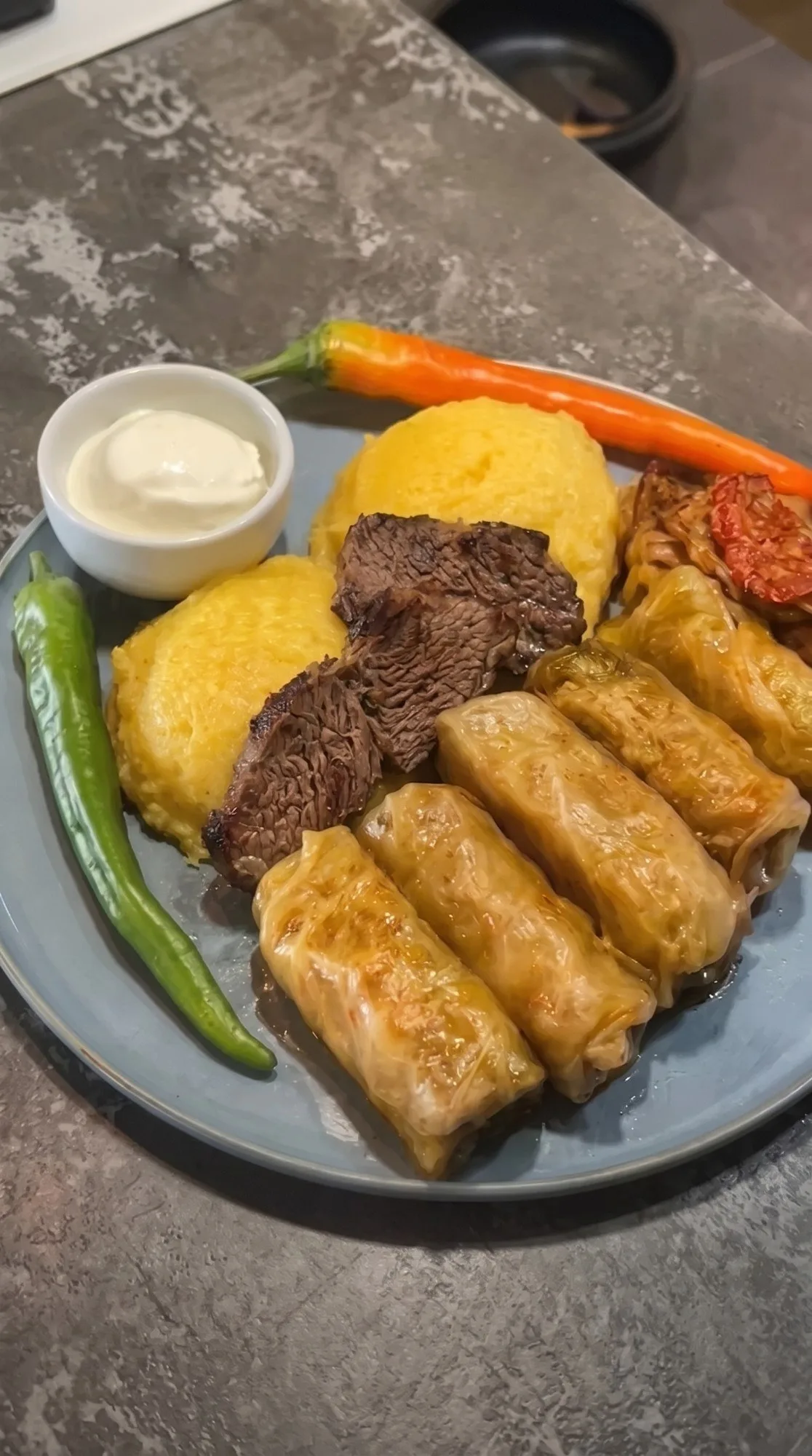
The plate in the photograph shows golden cabbage rolls, two mounds of polenta, slices of meat, cabbage with tomato, sour cream in a small bowl, and green and orange chili peppers. We keep this arrangement and use beef for both the filling and the braised meat.
The story of beef cabbage rolls
Stuffed cabbage rolls belong to a family of dishes found throughout southeastern Europe and the eastern Mediterranean, in which leaves are wrapped around a filling. The Romanian name is related to the Turkish term “sarma,” associated with wrapping. Historical connections with the Ottoman world helped spread the dish; a single, precise local origin cannot be established.
For this version, we take Moldavia as our regional reference, with fermented cabbage leaves, a rice filling, and polenta and sour cream on the side. However, cabbage rolls are cooked throughout Romania, and their size, seasonings, and proportion of rice vary between households. In Bulgaria, they are called “sarmi,” and in Serbia, “sarma,” with fillings and accompaniments that are not identical.
Over time, recipes have adapted to available ingredients, household tastes, and the cookware used. Slow cooking has remained important, whether on the stovetop or in the oven. Beef filling is one possible variation; serving sliced braised beef alongside is a choice for this plate, not a rule for Moldavian cabbage rolls.
Why you'll love it
- Fermented cabbage adds acidity and balances the meat and rice filling.
- Cooking covered softens the leaves without drying out the cabbage rolls.
- The roast and stuffed cabbage rolls use the same oven temperature.
- Soft polenta and sour cream complement the sauce on the plate.
- The stuffed cabbage rolls can be prepared the day before and are easy to reheat.
Beef Cabbage Rolls with Polenta and Braised Roast
Everything you need, in one place.
- Prep time
- 60 min
- Cook time
- 200 min
- Rest time
- 15 min
- Total time
- 275 min
- Servings
- 4
Ingredients
For approximately 20 cabbage rolls
For the braised beef
For the polenta
For serving
Instructions
Preparing the stuffed cabbage rolls
- Prepare the cabbage: separate the leaves, trim down the thick ribs, and chop the rest; if it is very salty, rinse the leaves and drain them well.
- Soften the onion in the 15 ml of oil over low heat for 5 minutes, until translucent but not browned.
- Mix the filling ingredients: ground beef, rice, lukewarm onion, thyme, and pepper, adding salt only if necessary.
- Roll approximately 20 stuffed cabbage rolls, dividing the filling evenly among the leaves and wrapping them slightly loosely to allow the rice to expand.
- Arrange the cabbage rolls in an ovenproof pot with a lid, over half the chopped cabbage and the bay leaves, with the remaining cabbage and tomato slices on top.
- Pour the stock mixed with the puréed tomatoes over the cabbage rolls; in a suitably snug pot, the liquid should reach almost to the top layer.
The braised beef and slow cooking
- Brown the piece of beef, seasoned with salt and pepper, in the 30 ml of oil in a small pot with a lid over medium-high heat for approximately 10 minutes in total, until a crust forms on all sides.
- Pour the 350 ml of stock over the meat and keep the pot over low heat for approximately 5 minutes, until the liquid begins to simmer gently.
- Cook both pots covered in an oven preheated to 160 °C, without fan assistance, for approximately 180 minutes, until the leaves are soft, the rice is cooked through, and a fork slides easily into the braised beef.
- Uncover the dish of stuffed cabbage rolls for the final 20 minutes of baking so that the top leaves and tomatoes turn golden.
Making the polenta and resting the dishes
- Bring the salted water to a boil over high heat approximately 30 minutes before the oven cooking time ends; heating takes around 5 minutes.
- Cook the cornmeal, sprinkled gradually into the water, over low heat for approximately 25 minutes, stirring frequently, until the polenta is thick and no hard grains remain.
- Let the braised beef and cabbage rolls rest for 15 minutes after removing them from the oven, keeping the polenta covered in the meantime.
Plating
- Cut the braised beef into slices across the grain, using a sharp knife.
- Shape two mounds of polenta on each plate, using a large spoon moistened with warm water.
- Complete each plate with approximately 5 cabbage rolls, slices of beef, a little cabbage with tomato from the pot, a small bowl of sour cream, and one green and one orange pepper.
Nutrition estimate: 1,030 kcal — per serving. Values vary with ingredients and portion size.
Tips for success
- Taste the cabbage before preparation. If it is very salty, soak it in cold water for 20 minutes while preparing the other ingredients.
- Choose ground beef with a little fat; a completely lean filling may turn out dry after prolonged cooking.
- Use a small dish for the roast so that the stock reaches approximately halfway up the piece of meat.
- Check the liquid after approximately 90 minutes. If it has reduced significantly, top it up with a little hot water without completely covering the stuffed cabbage rolls.
- If the roast resists when pierced with a fork, continue cooking it covered in 20-minute intervals; the time depends on the cut you choose.
Mistakes to avoid
- The leaves remain tough along the ribs. The thick rib takes longer to cook; trim it thinner with a knife before rolling.
- The cabbage rolls come undone. Packing the filling too tightly leaves no room for the rice; roll without tightening excessively and fold the ends inward.
- The dish is too salty. The cabbage and stock may already provide enough salt; use unsalted stock and check the cabbage before seasoning.
- The braised beef seems dry when sliced. Meat sliced immediately loses more juice; allow it to rest and slice against the grain.
- The polenta has lumps. Cornmeal added all at once forms lumps; sprinkle it in gradually and stir vigorously at the beginning.
Variations
- For a turkey filling, replace the 400 g of ground beef with 400 g of ground turkey thigh; keep the quantities of rice and leaves the same.
- If you cannot find fermented cabbage, use 1200 g of fresh cabbage and leaves, blanched until flexible, and add 20 ml of lemon juice to the cabbage rolls' cooking liquid. The flavor will be less tangy.
- Outside Romania, you can replace the 240 g of cornmeal with 240 g of cornmeal labeled “polenta.” If it is precooked, follow the water quantity and cooking time on the package.
- For serving, the 160 g of sour cream can be replaced with 160 g of cultured cream labeled “crème fraîche” or full-fat Greek yogurt; the yogurt will taste tangier.
Serving and storage
Serve the cabbage rolls with the two mounds of polenta, slices of braised beef, cabbage and tomato from the pot, sour cream separately, and chili peppers alongside, as in the photograph. Cool leftovers in shallow containers and refrigerate within 2 hours; keep the cabbage rolls and braised beef for 3–4 days, and the polenta for 2–3 days, at no more than 4 °C. The cabbage rolls and braised beef, with a little sauce, can be frozen separately for up to 3 months; add fresh sour cream and peppers. Thaw in the refrigerator and reheat the dishes covered, with a little water, at 160 °C, without fan assistance, until they reach 74 °C in the center; refrigerated portions usually require 25–35 minutes.
Small culinary glossary
- Cabbage rolls
- Rolls made from edible leaves wrapped around a filling. Here we use fermented cabbage leaves, beef, and rice.
- Fermented cabbage
- Cabbage fermented in brine, with a tangy, salty flavor. The whole leaves are used to wrap stuffed cabbage rolls.
- Polenta
- A dish made from cornmeal boiled in salted water. Its consistency can be soft or firm enough to portion.
- Sour cream
- A thick dairy product with a slightly tangy taste. Serve alongside the cabbage rolls.
- To braise
- To cook food covered, with a little liquid and moderate heat. This method helps cuts of meat with connective tissue become tender.
Frequently asked questions
Can I prepare the stuffed cabbage rolls a day ahead?
Yes. You can cook them fully, then cool and refrigerate them in their sauce. The next day, reheat them covered and prepare the polenta close to serving time.
Do I need to cook the rice before making the filling?
Not for this recipe. The rinsed rice goes into the filling raw and cooks in the liquid in the pot. Keep the rolls slightly loose so the grains have room to expand.
How do I check whether the cabbage rolls are done?
Open a stuffed cabbage roll from the center of the dish: the leaf should cut easily, and the rice should no longer have a hard center. If using a thermometer, the beef filling must reach at least 71 °C.
What should I do if the roast is ready before the stuffed cabbage rolls?
Remove the roasting dish and keep the meat covered in its sauce while you finish cooking the stuffed cabbage rolls. If they still need a lot of time, check the liquid and continue cooking them covered in 20-minute intervals.
Can I freeze just the stuffed cabbage rolls without the other components?
Yes. Freeze them after cooling, in meal-sized containers, with a little sauce between them. Prepare or add the polenta, sour cream, and peppers on the day of serving.
How did it turn out?
Share your experience or ask a question in the comments.
Leave a comment ↗