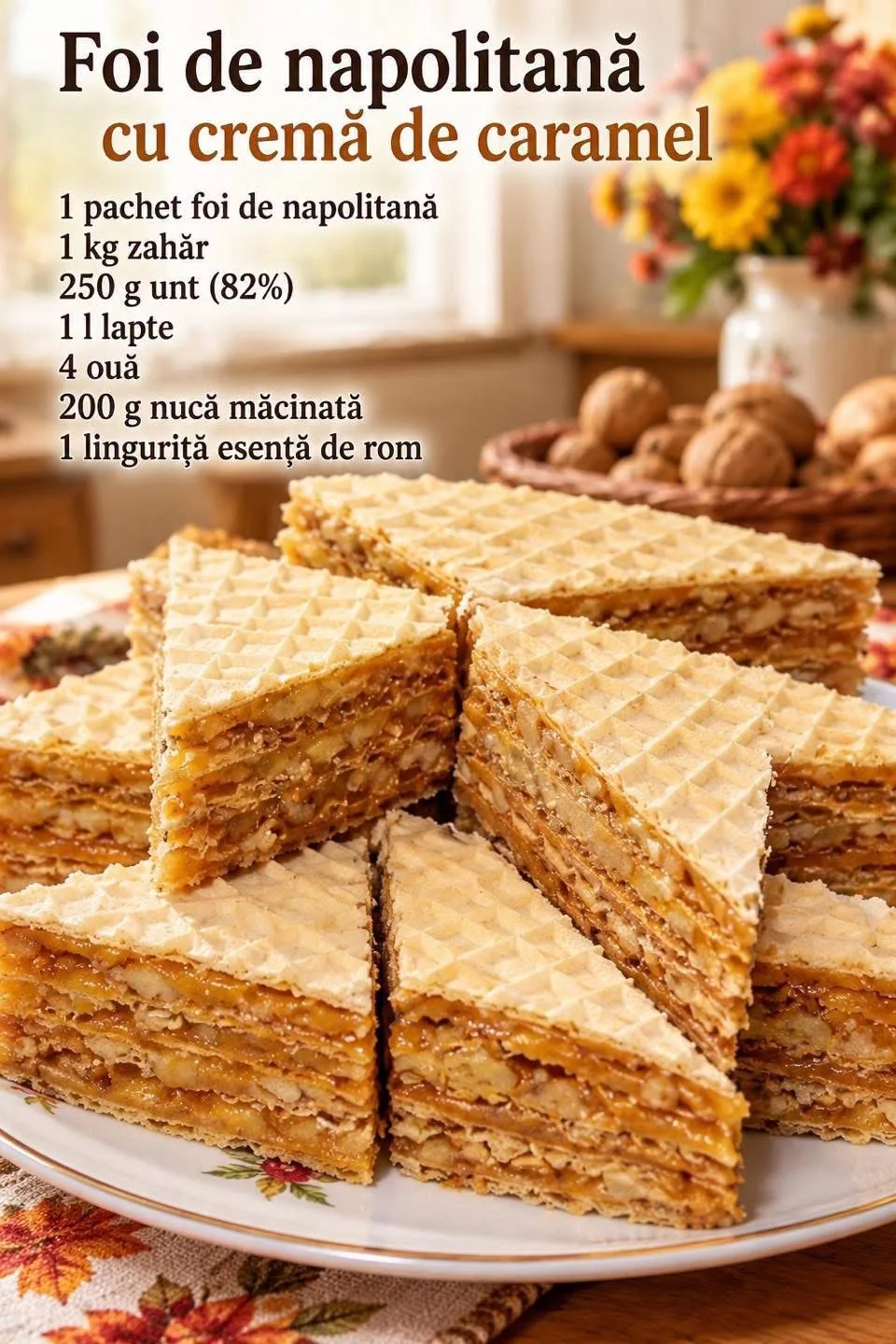
The photograph shows thick triangles with light-colored wafer sheets and a copper-colored filling, arranged on a floral platter. For the same appearance, we leave the top sheet plain and grind the walnuts more coarsely so they stand out in the cream.
The story of wafer sheet cake
The cake belongs to the family of European desserts made with thin sheets, baked between patterned plates and then filled. The name “napolitană” refers to Naples, but this does not prove that the caramel and walnut version originated there. The exact origin of this combination in Romanian kitchens is not sufficiently documented to attribute it to a single birthplace.
We present it as a homemade version also found in Transylvania, not as a specialty exclusive to the region: the cake is widespread throughout the country. Related desserts are also made in neighboring countries. In Hungary, the sheets are known as “ostya,” while in Serbia, cakes made with sheets and filling are often called “oblande”; fillings vary from household to household.
The availability of ready-baked wafer sheets made preparing these desserts at home easier. Many variations of the cream emerged, with milk, cocoa, walnuts, or butter, without all following the same recipe. This version retains the stovetop caramel and lengthy pressing, which helps the layers bind together and allows for neat slicing.
Why you'll love it
- No oven needed: you only cook the filling on the stovetop.
- Golden caramel and walnuts flavor every layer, without icing or additional decoration.
- After pressing, you can cut triangles with clearly defined layers.
- It is prepared the day before, so all that remains the next day is cutting it into portions.
- One large tray yields 32 small servings, suitable for a rich dessert.
Wafer Sheet Cake with Caramel and Walnuts
Everything you need, in one place.
- Prep time
- 30 min
- Cook time
- 80 min
- Rest time
- 510 min
- Total time
- 620 min
- Servings
- 32
Ingredients
For the layers
For the caramel and walnut filling
Instructions
Preparing the ingredients
- Grind the walnuts coarsely into small granules, not a paste.
- Beat the eggs in a large bowl until the whites and yolks are fully combined.
The caramel filling
- Heat the milk with 600 g of sugar in a saucepan over low heat for approximately 10 minutes, until the sugar has dissolved and the milk is steaming.
- Caramelize the remaining 400 g of sugar in a wide, heavy-bottomed saucepan over medium-low heat for approximately 12 minutes, until amber-colored.
- Pour the hot milk over the caramel in small portions, stirring with a long-handled spatula for approximately 5 minutes, until the hardened pieces dissolve; the mixture will bubble up and release hot steam.
- Cook the base over medium-low heat for approximately 45 minutes, stirring frequently along the bottom, until reduced to approximately 1250–1300 g and it falls from the spatula in a thick ribbon; toward the end, stir almost constantly.
- Cool the base with the bottom of the saucepan in a bowl of cold water, without letting water enter the filling, for approximately 10 minutes, until it reaches 70–75°C.
- Temper the eggs by gradually incorporating approximately 300 g of the warm base into the bowl, whisking constantly.
- Cook the egg mixture together with the rest of the base in the saucepan over very low heat for approximately 8 minutes, stirring constantly, until it reaches 82–84°C and thickly coats the spatula, without boiling vigorously.
- Stir the butter, walnuts, vanilla, and salt into the filling off the heat, until the butter is completely melted and evenly incorporated.
- Let the filling cool for approximately 20 minutes, until lukewarm and spreadable, not hot.
Assembly and pressing
- Assemble the cake on a tray lined with parchment paper, alternating 6 sheets measuring approximately 28 × 38 cm with 5 equal portions of filling, leaving the final sheet uncovered.
- Cover the cake with parchment paper and a flat tray, placing its base against the sheets.
- Press the cake in the refrigerator for 8 hours, with a weight of approximately 1000 g evenly distributed over the top tray.
- Cut the cold cake into 16 rectangles using a serrated knife and gentle strokes.
- Cut each rectangle in half diagonally to obtain 32 triangles.
Nutrition estimate: 285 kcal — per serving. Values vary with ingredients and portion size.
Tips for success
- Use a wide saucepan, approximately 26–28 cm across: in a narrow pan, evaporation takes longer than the indicated time.
- Weigh the empty saucepan before starting. This makes it easier to check how much the caramel base has reduced, without relying solely on minutes.
- A kitchen thermometer helps with the egg stage: the filling must be heated in a controlled manner, not brought to a rolling boil.
- Spread the filling in an even layer almost to the edges. Pressing will push it slightly outward.
- Clean the knife blade between cuts so the filling does not smear the faces of the triangles.
Mistakes to avoid
- Overly dark caramel. Overheated sugar becomes bitter; stop caramelizing when it turns amber and add the prepared milk.
- Base not reduced enough. Too much water leaves the filling soft and makes the sheets excessively soggy; watch for a thick consistency and check the amount remaining after cooking.
- Eggs added directly to the very hot base. Sudden heat causes curdled bits to form; let the base cool and temper the eggs before the final heating.
- Filling with hot cream. The sheets may warp and the filling may run; wait until it is lukewarm and spreads without running.
- Too much weight when pressing. The sheets break and the filling spills out at the edges; use a flat tray and a moderate, evenly distributed weight.
Variations
- For a hint of cocoa, replace 20 g of the walnuts with 20 g of sifted cocoa powder, incorporating it along with the butter.
- For a citrus flavor, replace the vanilla with 5 g of finely grated orange zest from a fruit whose peel is suitable for consumption.
- For a filling with a different texture, replace 100 g of the walnuts with 100 g of roasted, coarsely ground hazelnuts.
- If cooking abroad, look for plain rectangular wafer sheets for cakes, unsweetened and unfilled; use approximately 250 g and keep the same surface area for the layers. Do not replace them with thick biscuits if you want the appearance shown in the photograph.
Serving and storage
Arrange the plain triangles on a platter with the layers visible, as in the photograph; coffee or unsweetened tea makes a good accompaniment. Store the cake in a sealed container in the refrigerator for up to 4 days, separating the portions with parchment paper. You can freeze it in portions for up to a month, well wrapped, although the sheets will be softer after thawing. Thaw slowly in the refrigerator and take the portions out approximately 10 minutes before serving; they do not need reheating.
Small culinary glossary
- Wafer sheets
- Very thin, light sheets with an embossed pattern, used for layered cakes. For this recipe, use plain, unfilled sheets.
- To caramelize
- To heat sugar until it melts and turns golden or copper-colored. An overly dark color indicates a bitter taste.
- To temper eggs
- To warm eggs gradually by adding a small amount of a warm mixture. This process reduces the risk of sudden coagulation.
- To reduce
- To cook a mixture to remove some of its water. This makes the filling more concentrated and thicker.
- To press
- To hold the cake under an evenly distributed weight. The sheets adhere to the filling, and the layers settle evenly.
Frequently asked questions
Can I reduce the amount of sugar?
Sugar contributes to both the flavor and the consistency of the caramel, so a large reduction changes how the filling sets. For this version, keep the proportions and cut small servings. If you want a smaller cake, halve all the ingredients and use sheets with half the surface area.
How do I know the caramel base has reduced enough?
Before adding the eggs, butter, and walnuts, the base should weigh approximately 1250–1300 g and flow slowly off the spatula. The time may vary depending on the width of the saucepan and the heat level; consistency and weight are more useful guides than the timer alone.
What should I do if the package contains a different number of sheets?
Check the dimensions first. You can trim larger sheets to obtain 6 rectangles measuring approximately 28 × 38 cm. If you use much smaller sheets, reduce the filling proportionally; otherwise, the layers will be too thick and unstable.
Should the sheets remain completely crisp?
No. After pressing, they absorb a little moisture from the filling and become easier to cut, but they should remain distinct. Very soft sheets with runny filling usually indicate an insufficiently reduced base.
Can I make it a day ahead?
Yes, it is ideal for preparing the day before. Leave it weighted down in the refrigerator for at least 8 hours and cut it into portions the next day while cold.
How did it turn out?
Share your experience or ask a question in the comments.
Leave a comment ↗