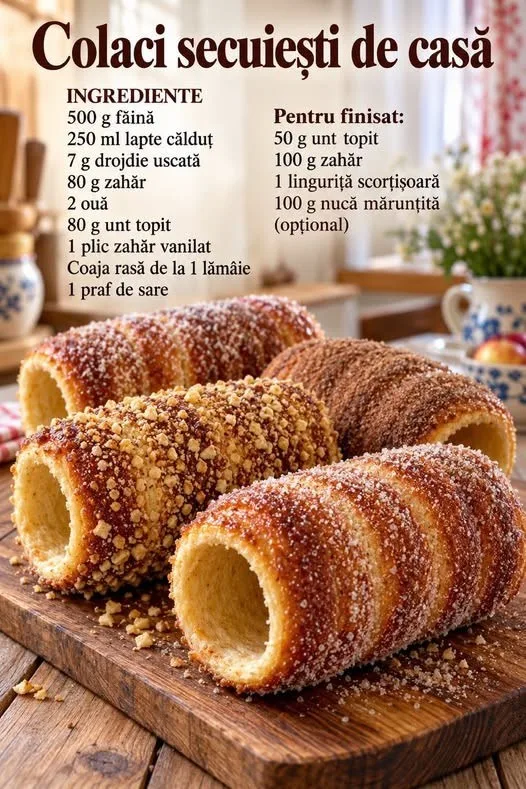
The secret to the shape is the spiral of dough, wrapped tightly and smoothed before baking. We explain the method for a conventional oven: you get four large chimney cakes, or eight servings, with a golden, slightly uneven surface, as shown in the photograph.
The story of chimney cakes
Székely chimney cakes are linked to the pastry-making traditions of Hungarian communities in Transylvania, particularly the Székely community. The Hungarian name, kürtőskalács, refers to the pastry's chimney shape. A written recipe is documented in Transylvania in the eighteenth century, but this does not establish the exact time of its origin.
In Romania, this food is associated mainly with Transylvania, the region we describe here. In Hungary, it is also known as kürtőskalács. Other parts of Central Europe have related products, such as trdelník, but a similar shape does not mean they all share the same recipe or a single origin.
Baking on a cylinder rotated over embers remains the traditional method that gives the crust pronounced caramelization. Over time, specialized equipment and versions adapted for home ovens have become widespread, and the finishes have become more varied. Our version retains the yeast dough, tubular shape, and sugar coating, using a conventional oven and molds suitable for it.
Why you'll love it
- The dough made with milk, eggs, and butter stays fluffy beneath the thin sugar crust.
- From the same batch of dough, you make four large chimney cakes with three different finishes.
- The spiral can be pulled apart into strips, making it easy to share at the table.
- The lemon zest and vanilla sugar add flavor without overpowering the taste of the walnuts.
- The recipe uses a conventional oven, provided you have suitable cylindrical molds.
Homemade Szekler Chimney Cakes with Sugar, Walnuts, and Cinnamon
Everything you need, in one place.
- Prep time
- 45 min
- Cook time
- 25 min
- Rest time
- 80 min
- Total time
- 150 min
- Servings
- 8
Ingredients
For the dough
For shaping
For the molds and finishing
Instructions
Preparing the dough
- In a bowl, mix the flour for the dough, instant yeast, sugar, vanilla sugar, salt, eggs, lemon zest, and lukewarm milk at approximately 30–35°C until no dry flour remains.
- Knead for 12–15 minutes, gradually incorporating the softened butter, until the dough becomes elastic and only slightly sticky.
- Cover the dough and let it rise for approximately 60 minutes in a draft-free place until doubled in volume.
Shaping on the molds
- Preheat the oven to 200°C, without the fan, before you begin shaping.
- Use 10 g of the melted butter to grease four oven-safe cylindrical metal chimney cake molds with a usable area approximately 18 cm long and 5 cm in diameter.
- Roll out the dough on a work surface dusted with the flour for shaping, into a sheet 5–6 mm thick.
- Cut the rolled-out dough into strips approximately 2 cm wide.
- Wrap the strips spirally around the molds, dividing the dough evenly among them, with the edges slightly overlapping and the joins firmly sealed.
- Gently roll each mold on the work surface until the spiral joins together and the thickness is even.
- Let the shaped chimney cakes rise for another 15 minutes, loosely covered.
Baking and finishing
- Brush the dough with the remaining 40 g of melted butter in a thin, even layer.
- Roll the molds in the sugar spread on a platter so that the entire surface of the dough is coated.
- Bake the chimney cakes for approximately 25 minutes at 200°C, without the fan, with the molds supported horizontally only at their ends over a deep baking tray, turning them with heat-resistant gloves every 5 minutes; when done, the surface should be amber, and the dough between the coils should no longer look wet.
- Immediately roll one chimney cake in the chopped walnuts and another in cinnamon while the outer layer is still hot and sticky; leave the other two with their sugar finish.
- Remove the chimney cakes from the molds after approximately 2 minutes with a gentle twisting motion, using heat-resistant gloves.
- Let the chimney cakes cool for another 3 minutes on a wire rack before serving.
Nutrition estimate: 550 kcal — per serving. Values vary with ingredients and portion size.
Tips for success
- Prepare four molds with stable supporting ends that fit in the oven at the same time without the dough touching the tray or the neighboring chimney cake. If you need two batches, the total time increases.
- Do not add too much flour when kneading. The dough comes together as you work it, and slight stickiness is normal.
- Keep the rolled-out dough the same thickness throughout; thicker areas take longer to bake near the mold.
- Prepare the walnuts and cinnamon on platters before taking the chimney cakes out of the oven. The hot sugar hardens quickly.
- Watch the color during the final minutes: the sugar should be amber, not very dark brown.
Mistakes to avoid
- Milk too hot. High temperatures can affect the yeast; use only lukewarm milk, with its temperature measured before mixing.
- Widely spaced coils. Gaps expand during proofing and weaken the chimney cake; overlap the edges slightly and smooth by rolling.
- Layer of dough too thick. The outside browns before the inside is baked; roll the dough to the specified thickness and distribute it evenly.
- Molds left stationary. Heat does not reach all sides evenly; turn the molds regularly and check the surface facing the top of the oven.
- Finishing after cooling. Walnuts no longer stick well to hardened sugar; apply them immediately after baking.
Variations
- For a hazelnut finish, replace the 60 g of walnuts with 60 g of finely chopped hazelnuts.
- For a coconut chimney cake, replace the walnuts intended for that cake with 40 g of finely shredded coconut, applied immediately after baking.
- For an orange flavor, replace the 5 g of lemon zest with 5 g of grated orange zest from an orange with peel suitable for consumption.
- If you are baking outside Romania and cannot find flour for cozonac, use 500 g of white all-purpose baking flour, not self-rising flour. Initially reserve 20 ml of the measured milk and add it only if the dough absorbs it.
Serving and storage
We serve them plain and warm, arranged on a wooden board with the finishes visible. One large chimney cake is enough for two servings. Once completely cool, keep them in a sealed container for up to 24 hours at room temperature or up to 3 days in the refrigerator; the crust will gradually soften. You can freeze them individually for up to 2 months, well wrapped. After thawing, reheat them for 6–8 minutes at 160°C, without the fan, on a rack placed over a baking tray; the texture will not be identical to that of the first day.
Small culinary glossary
- Yeast dough
- Dough leavened with yeast. As it rests, it increases in volume and develops an airy structure.
- Kneading
- Repeatedly working the dough to make it cohesive and elastic. This can be done by hand or with a mixer fitted with a dough hook.
- Caramelization
- The transformation of sugar at high temperatures, when it develops an amber color and distinctive flavor. If it becomes too dark, the taste turns bitter.
- Crumb
- The soft interior of baked dough. In these chimney cakes, the crumb is in the cylindrical wall, not in the hollow center.
- Crust
- The outer layer formed during baking. Here it is thin, coated with sugar, and crispest while the chimney cakes are fresh.
Frequently asked questions
What molds do I need to achieve the look in the photograph?
You need cylindrical chimney cake molds approved for oven use and fitted with supporting ends. For this quantity, four molds with a usable area approximately 18 cm long and 5 cm in diameter are suitable. Do not improvise with painted or varnished objects or objects with plastic parts.
Can I replace dry yeast with fresh yeast?
Yes. Use 20 g of fresh yeast instead of the 7 g of instant dry yeast. Dissolve it in the lukewarm milk from the recipe before mixing, and watch for the dough to double in volume rather than relying only on the stated time.
Can I prepare the dough the night before?
Yes. After kneading, place it in a large, covered container in the refrigerator for 8–12 hours instead of letting it rise for 60 minutes at room temperature. Before rolling it out, leave it on the counter for approximately 45–60 minutes until it becomes easy to work with. This option increases the total time.
Why don't they caramelize evenly in my oven?
In conventional ovens, heat does not reach all sides of a cylinder evenly. Check that the oven is preheated, leave space between the chimney cakes, and turn the molds every 5 minutes. The crust may be somewhat less even than when baked on a continuously rotating device.
How did it turn out?
Share your experience or ask a question in the comments.
Leave a comment ↗