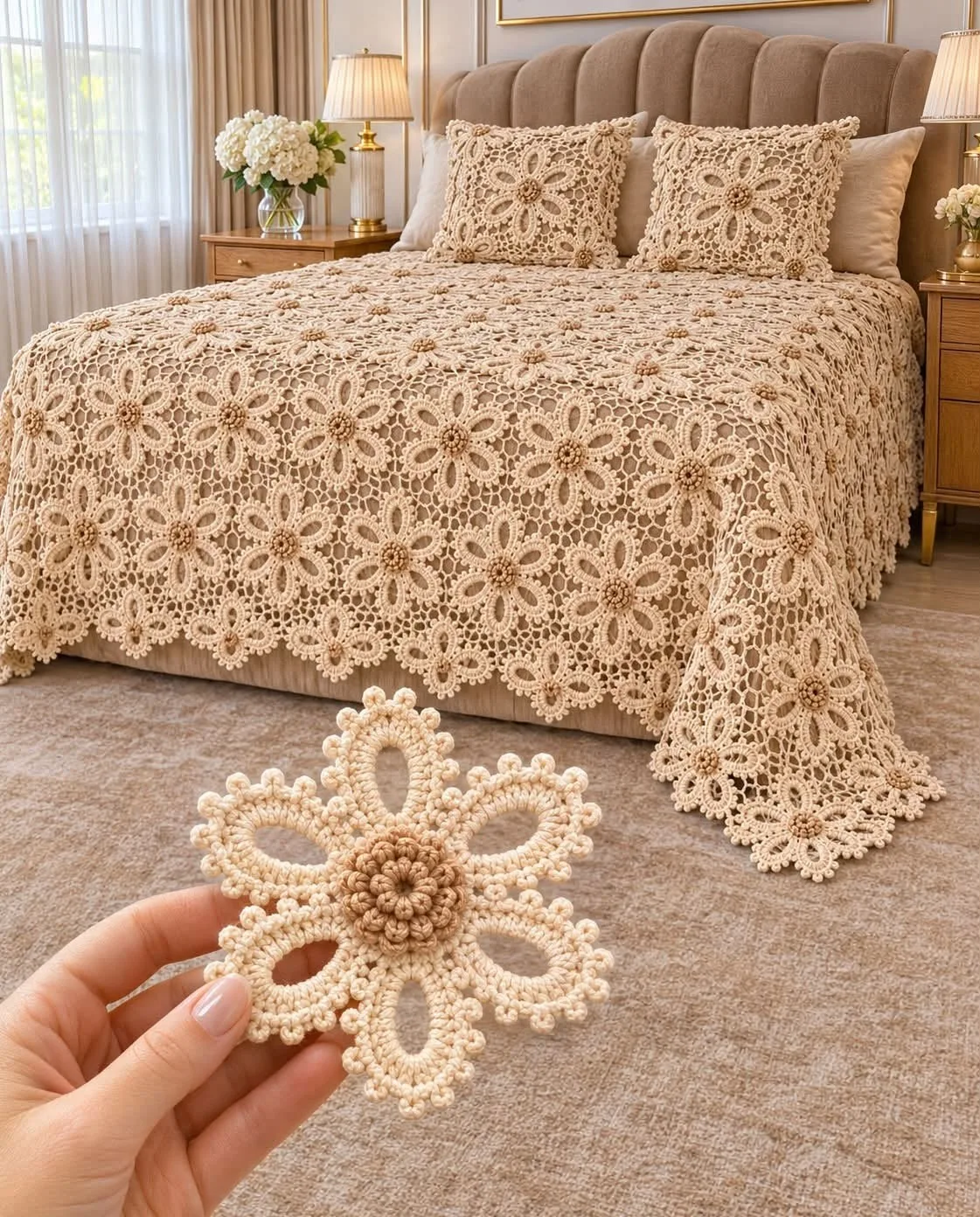
Beige Crochet Flower Bedspread with Openwork Lace
- Difficulty
- advanced
- Time
- 240-300 hours
- Yarn weight
- Fine / category 2
- Crochet hook
- 3 mm
- Gauge
- 1 motif = 14 x 14 cm
- Finished size
- Approx. 236 x 264 cm
This crochet flower bedspread pattern combines open petals in light beige, toasted beige centers with small bobbles, and a mesh that joins the flowers without overshadowing them. Each main flower has six elongated petals with small picots. A border of smaller flowers forms the scalloped outline visible in the image.
The bedspread is made from 288 square lace motifs and 140 small flowers for the border. It is an advanced project for those who enjoy counting spaces, joining motifs, and carefully blocking pieces. Allow about 240-300 hours for the motifs, seams, and finishing; it is best to work in batches and check the measurements before preparing all the pieces.
Materials
- Fine cotton yarn, category 2, in light beige or cream Approximately 8200-9000 m, including an allowance for swatches and joining.
- The same cotton yarn in toasted beige Approximately 1100-1300 m for the centers.
- 3 mm crochet hook Adjust the size to achieve the specified blocked motif measurements.
- Blunt-tipped yarn needle For joining the motifs and weaving in the ends.
- Stitch markers Six for the petal tips and four for the corners.
- Scissors, measuring tape, and rustproof pins Use a sufficiently large blocking surface.
Abbreviations
AMMagic ring.cadChain.pbSingle crochet; equivalent to sc in US terminology.paDouble crochet; equivalent to dc in US terminology.pdSlip stitch.HTBack loop only.espSpace.pStitch or stitches.vtaRound.Special stitches and working guidelines
- Bobble: work 3 dc closed together in the same st. For each dc, yarn over, insert the hook, draw up a loop, and pull through only the first two loops. After preparing the three dc, you will have four loops; yarn over and pull through them together. The bobble counts as 1 st. Push it toward the right side.
- Picot: ch 3 and work 1 sl st in the first of those 3 ch. The picot is not included in the round's sc count.
- All rounds are worked with the right side facing you, without turning. The starting ch, when specified, does not count as a st. Joining sl sts and those that close picots are not included in the totals; explicitly specified sl sts used to move to another position are detailed.
- Number the chain stitches of each petal from its base. The sc covering the petal are worked into the individual chain stitches, not around the entire arch.
Gauge, measurements, and layout
- The main gauge swatch is one complete motif through round 11, blocked to 14 x 14 cm. Its inner flower should remain open and centered, without the mesh pulling on the points.
- Prepare 288 main motifs and arrange them in 16 columns and 18 rows. The central rectangle measures approximately 224 x 252 cm before the border.
- The border adds approximately 6 cm on each side. The expected finished dimensions are 236 x 264 cm, with slight variations depending on blocking.
- To change the size, use complete columns and rows. With A columns and B rows, you will need A multiplied by B large motifs and 4 multiplied by the sum of A and B, plus 4, small flowers. The approximate dimensions will be 14A + 12 cm by 14B + 12 cm.
Main motif: raised center
- Round 1: with toasted beige yarn, work 6 sc in a magic ring. Tighten the ring and join with a sl st in the first sc. Total: 6 sc.
- Round 2: ch 1. Work a bobble and 1 sc in each st of the previous round. Join with a sl st in the first bobble. Total: 12 sts, consisting of 6 bobbles and 6 sc.
- Round 3: ch 1. Work a bobble and 1 sc in each of the 12 sts. Join with a sl st. Total: 24 sts, consisting of 12 bobbles and 12 sc. Cut the tan yarn and fasten off on the back.
Main motif: six open petals
- Round 4: join the light beige in the back loop of any center st. Work this sequence six times: 1 sc in the back loop of the next st; ch 17; 1 sl st in the same base loop where you worked that sc; 1 sc in the back loop of each of the next 3 sts. Join with a sl st. Total: 24 sc, 6 loop-closing sl sts, and 6 ch-17 loops. Each repeat uses 4 center sts.
- Round 5: cover each loop as follows: 1 sc in each of its first 8 ch, 3 sc in the ninth ch, and 1 sc in each of the last 8 ch. This makes 19 sc per petal. Add a picot after sc numbers 2, 4, 6, 8, 10, 12, 14, 16, and 18. Mark sc number 10, which is the center of the tip.
- After covering each petal, work 1 sl st in its base sc and 1 sl st in each of the 3 sc separating it from the next petal. Repeat around and join. Round 5 total: 114 sc, 54 picots, and 24 traveling sl st. There should be six distinct points. Cut the yarn to begin the mesh from a point.
Main motif: mesh and conversion to a square
- Round 6: join light beige yarn in the marked sc at a point, below its picot. Work 1 sc in each of the six points, separating each sc from the next with 10 ch. Join with a sl st. Total: 6 sc and 6 ch-10 spaces; there are no corners yet.
- Round 7: work 1 sc in each sc of round 6 and 1 sc in the fifth ch of each ch-10 arch. Separate all these consecutive sc with 5 ch. Join with a sl st. Total: 12 sc and 12 ch-5 spaces; there are no corners yet.
- Round 8: sl st to the first space. Work this sequence four times: in the next space, work 1 sc, ch 7, and 1 sc for a corner; ch 5, 1 sc in the next space; ch 5, 1 sc in the next space; ch 5. On the first repeat, use the space you are in as the first space. Join with a sl st. Total: 16 sc, 4 ch-7 corner spaces, and 12 ch-5 side spaces, three per side. Mark the four corners.
- Round 9: move to a corner space. In each corner, work 1 sc, ch 5, and 1 sc. Between corners, ch 5 and work 1 sc in each of the 3 side spaces; finish each side with another 5 ch to the next corner. Join with a sl st. Total: 20 sc and 20 ch-5 spaces: 4 corner spaces and 16 side spaces, four per side.
- Round 10: at each corner, work 1 sc, 5 ch, and 1 sc. Between corners, work 5 ch and 1 sc in each of the 4 side spaces; end each side with 5 ch. Join with a sl st. Total: 24 sc and 24 ch-5 spaces: 4 corner spaces and 20 side spaces, five per side.
- Round 11: at each corner, work 1 sc, 5 ch, and 1 sc. Between corners, work 5 ch and 1 sc in each of the 5 side spaces; end each side with 5 ch. Join with a sl st and fasten off. Total: 28 sc and 28 ch-5 spaces: 4 corner spaces and 24 side spaces, six per side.
- Block the motif to 14 x 14 cm. Place the corner pins in the third chain stitch of each corner arch. Open the petals with your fingers and keep the picots separated, without stretching them out of shape.
Arranging and joining the 288 motifs
- Arrange 16 motifs per row and prepare 18 rows, all with the right side facing up and the flowers oriented the same way. Join only motifs that have already been blocked and dried.
- Each joining edge begins at the third ch of one corner and ends at the third ch of the next. This path contains 43 positions: 7 sc, the 30 ch of the six side arches, and 6 ch belonging to the two half-corners.
- Using light beige yarn and a yarn needle, sew stitch to stitch with a loose whipstitch, picking up one strand from each opposing position. Match the chain stitches individually as well; do not catch an entire arch with a single stitch. Keep the pieces flat as you sew.
- First join the motifs in each row: 15 seams per row and 270 in total. Then join the 18 rows with 16 seams at each junction: another 272. Total: 542 side joins.
- At each junction of four motifs, bring their four central corner chains together with a small stitch. Do not close the lace spaces surrounding them. At perimeter junctions, treat the two central chains sewn together as a single reference point.
Border: foundation mesh round
- Mark as anchors all visible sc around the perimeter of round 11, the third ch of each side arch, and the third ch of each corner arch that lies on the perimeter. At motif junctions, count the shared central chain only once.
- Between the corner centers of each motif there are 14 anchor-to-anchor intervals. Therefore, each short side of the bedspread has 224 intervals and each long side has 252. The perimeter contains 952 distinct anchors before expanding the four outer corners.
- Border round 1: join light beige yarn at an outer corner. Work 1 sc, 5 ch, and 1 sc in that same anchor. Work along each side, making 3 ch between anchors and 1 sc in each regular anchor. At the other three outer corners, repeat 1 sc, 5 ch, and 1 sc. Join with a sl st.
- Total for this round: 956 sc, 952 ch-3 spaces, and 4 ch-5 corner spaces. Each short side retains 224 ch-3 spaces, and each long side, 252. Do not add another round of sc: the flowers are attached directly to this mesh.
Small border flowers: make 140
- Round 1: with tan beige, work 6 sc in a magic ring. Join with a sl st. Total: 6 sc.
- Round 2: ch 1 and work a bobble and 1 sc in each st. Join with a sl st and fasten off the tan yarn. Total: 12 sts, consisting of 6 bobbles and 6 sc.
- Round 3: join the light beige. Work this sequence six times through the back loops of the center sts: 1 sc in the next st, ch 13, 1 sl st in the same base loop, and 1 sc in the next st. Join with a sl st. Total: 12 sc, 6 loop-closing sl sts, and 6 ch-13 loops.
- Round 4: in each loop, work 1 sc in each of the first 6 ch, 3 sc in the seventh ch, and 1 sc in each of the last 6 ch. This makes 15 sc per petal. Make a picot after sc numbers 2, 4, 6, 8, 10, 12, and 14. Mark sc number 8, located at the tip.
- After each petal, work 1 sl st in its base sc and 1 sl st in the sc separating it from the next petal. Join and fasten off. Round 4 total: 90 sc, 42 picots, and 12 traveling sl st. The flower has six petals and no corners.
- Block each flower to approximately 6 cm in diameter, measured between opposite tips. You need 136 flowers for the sides and 4 for the corners.
Positioning the border flowers
- Work around the bedspread in the same direction throughout. To position each flower, imagine the fabric above it: two petals face toward the bedspread, two sideways, and two outward. Number them following the direction of the border: petal 1 toward the fabric and backward; petal 2 toward the fabric and forward; petal 3 sideways and forward; petals 4 and 5 outward; petal 6 sideways and backward.
- Divide each side into blocks of 7 ch-3 spaces. You will have 32 blocks on each short side and 36 on each long side. Each block receives one flower, for a total of 136 side flowers.
- In each block, number the anchors from 0 to 7. Sew the tip sc of petal 1 to the sc of anchor 2, and that of petal 2 to the sc of anchor 5. Do not stitch through the picot: keep its small raised detail free. Make two short passes of yarn at each attachment and fasten off on the back.
- Place an additional flower at each outer corner. Its center sits outside the corner. Attach its petal 1 to the anchor two spaces before the corner and its petal 2 to the anchor two spaces after it, on the next side. These anchors also receive an attachment from the neighboring side flowers; this is intentional.
- Join consecutive flowers to complete the outline: with light beige, work 1 sl st in the tip of petal 3 of one flower, ch 3, and work 1 sl st in the tip of petal 6 of the next. Cut the yarn and fasten off each bridge. Include the four corner flowers as you go around, and also join the last flower to the first.
- Final floral border count: 140 flowers, 280 attachments to the bedspread, and 140 ch-3 bridges. Check the placement with pins before sewing permanently; the bridges should lie relaxed and the flowers should not overlap.
Finishing
Weave in the ends through stitches of the same color, changing direction at least once. At the centers, pass the needle behind the bobbles without flattening them. Check the joins on a light-colored surface to find any chain stitches left unmatched.
Dampen the bedspread following the cotton's care instructions and remove excess water without wringing. Lay it out fully supported, adjust the central rectangle, and then open out the floral border. Allow to dry completely. Do not lift the wet piece by a corner: its weight can stretch the mesh and distort the seams.
Tips for success
- Keep one blocked motif as a reference and compare each batch of eight or ten new motifs against it.
- Mark the central sc of each tip before closing the petal round. This will let you attach the mesh without confusing it with the picot.
- Work the chain stitches with slightly looser tension than the sc. A stiff mesh pulls the petals inward.
- Prepare the border on a flat surface and position the four corner flowers first. Then arrange the flowers along each side in blocks of seven spaces.
- Weigh the swatch and record the yarn used in each color. This information lets you adjust your purchase more precisely than a general estimate.
Common mistakes to avoid
- Counting a bobble as three stitches: the three dc are closed together and form a single st. Round 3 of the large center must end with 24 sts, not more.
- Covering the petals around the arch: the stitches can shift and lose the point. Insert them into the specified chains, with the three increase sc in the central ch.
- Choosing a corner every two spaces: in round 8, one corner space and two side spaces are used per repeat. There must be exactly four corners.
- Tightening the whipstitch: a short seam creates a channel between motifs. Undo that section and join again with both edges supported and without pulling the yarn.
- Counting a motif junction twice along the border: the central chain stitches sewn together form a single anchor. If the side does not end with 224 or 252 spaces, check those junctions first.
Ideas for customizing the pattern
- For a sofa throw, use 8 columns and 10 rows: 80 main motifs, 76 small flowers, and approximate dimensions of 124 x 152 cm.
- For a wider bed, use 18 columns and 20 rows: 360 main motifs, 156 small flowers, and approximately 264 x 292 cm.
- Keep the two shades in the photo, but choose a tan slightly closer to light beige to soften the raised texture of the centers.
- Choose mercerized cotton for more defined picots or well-twisted matte cotton for a softer finish. Check both swatches again before substituting yarn.
Frequently asked questions
Why is the flower round if the finished motif is square?
The first seven rounds form the center, the six petals, and their circular mesh. Round 8 introduces four corners; the next three rounds expand that square outline. When the motifs are joined, the mesh stays in the background and the flowers retain their silhouette.
What should I do if I achieve 14 cm, but the petals are tight?
Do not force the blocking. Check that each loop has 17 ch and that round 6 has 10 ch between tips. If the counts are correct, loosen your chain tension or try another hook on a complete swatch. The square should reach its measurements without stretching the flower.
Can the motifs be joined as you go?
This version is calculated for sewing the complete edges together after blocking. Joining during the last round would change the shared perimeter positions and require recalculating the border anchors. To preserve the specified counts, use the seam described.
How do I check that the small flowers will fit?
Prepare a swatch with two large motifs joined together and their border round. Four small flowers should fit along that section, each attached to anchors 2 and 5 of its block. The ch-3 bridges should reach the side tips without pulling. Adjust the swatch before making the 140 flowers.
Does it include the cushions shown on the bed?
No. The instructions cover the main bedspread and its floral border. The cushions in the image are not part of this pattern.