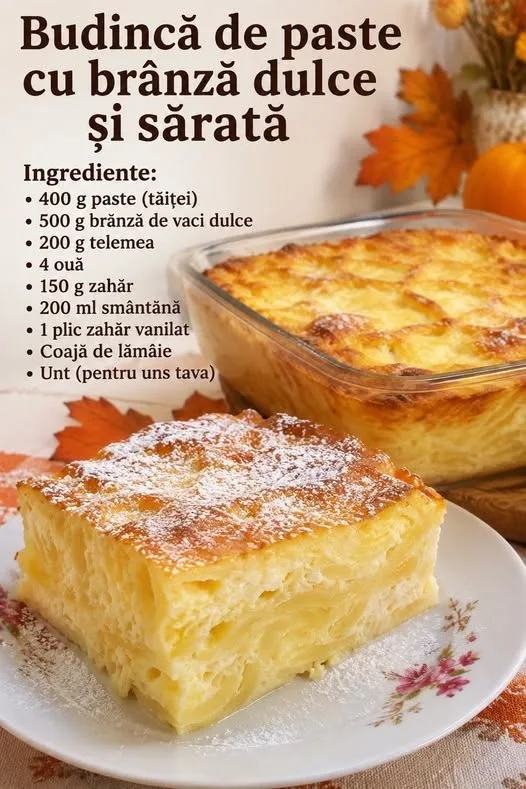
We use well-drained cottage cheese and let the pudding settle before cutting. This gives us tall pieces with visible layers of pasta, which we serve plain with a little powdered sugar, as shown in the photo.
The Story of Pasta Pudding with Unsalted and Salty Cheese
Cheese pasta pudding belongs to a family of dishes widespread in Central and Eastern European cuisines: pasta mixed with dairy products and eggs, then baked. The name describes the preparation method and the main ingredients. The exact origin of the combination of unsalted fresh cheese, telemea, and sugar is not sufficiently documented to attribute it to a single place.
In Muntenia, the region chosen for this version, macaroni or noodle pudding with cheese is a homemade dish also found in other parts of the country. Sweet noodle puddings are also prepared in the Republic of Moldova. The mixtures vary from household to household, especially in the amount of sugar and the type of cheese.
Over time, store-bought dried pasta joined homemade noodles in these puddings. Short pasta shapes and wide noodles are both used today, and the proportions of dairy ingredients remain flexible. In this version, we retain the sweet-and-salty combination and use wide pasta, which gives the slices their visible layers.
Why you'll love it
- The unsalted cheese and telemea give a balanced flavor, rather than just sweetness.
- The wide noodles form soft layers that are easy to see in each slice.
- The surface browns without having to prepare a separate dough.
- One pan yields eight generous servings.
- The pudding can be portioned and stored for the following days.
Pasta pudding with sweet and salty cheese
Everything you need, in one place.
- Prep time
- 25 min
- Cook time
- 55 min
- Rest time
- 20 min
- Total time
- 100 min
- Servings
- 8
Ingredients
For the pasta
For the cheese mixture
For the pan and serving
Instructions
Preparing the pan and pasta
- Preheat the oven to 180°C, without a fan.
- Butter the base and sides of a pan measuring approximately 20 × 30 cm and at least 5 cm deep.
- Boil the noodles in salted boiling water over medium-high heat for approximately 8 minutes, or 1–2 minutes less than the time indicated on the package, until they remain slightly firm in the center.
- Drain the noodles well in a colander.
Preparing the mixture
- Mash the cottage cheese with a fork until the large lumps are broken up.
- Grate the telemea using the large holes of a grater.
- Beat the eggs with the sugar and vanilla sugar for 2 minutes, until combined, without trying to create a voluminous foam.
- Incorporate the cottage cheese, telemea, sour cream, and lemon zest into the eggs.
- Mix the well-drained noodles with this mixture, using a spatula to avoid breaking them.
Baking and portioning
- Transfer the mixture to the prepared pan.
- Smooth the surface into an even layer.
- Bake on the middle rack for approximately 47 minutes, until the top is golden, the edges are browned, and the center is set; start checking at minute 45.
- Let the pudding cool in the pan for 20 minutes so that the slices hold their shape.
- Cut the pudding into 8 pieces with a sharp knife.
- Dust the pieces with powdered sugar just before serving.
Nutrition estimate: 500 kcal — per serving. Values vary with ingredients and portion size.
Tips for success
- Weigh the cottage cheese after draining. If it releases whey, leave it in a strainer in the refrigerator before you start preparing the recipe.
- Choose wide noodles with a cooking time close to 10 minutes; shortening the boiling time helps them stay intact in the oven.
- Taste the telemea before using it. If it is very salty, soak it in cold water for 20–30 minutes, then drain it well.
- If the surface browns too quickly, loosely cover the pan with baking parchment after the first 30 minutes.
- Add powdered sugar only to the portions being served; it melts quickly on the warm, moist surface.
Mistakes to avoid
- Fully cooked pasta. They continue cooking in the wet mixture and may become too soft; shorten the boiling time by 1–2 minutes compared with the package instructions.
- Cheese with too much whey. Excess liquid prevents the slices from holding their shape; drain the cheese before weighing.
- A pan that is too small. A very thick layer is difficult to cook through in the center; use the specified pan size and leave space below the rim.
- Cutting immediately after baking. The hot mixture is still fragile; allow the full 20 minutes of cooling time.
Variations
- For unsalted fresh cheese purchased abroad, use 500 g firm quark, weighed after draining. Avoid very runny varieties.
- Instead of telemea, you can use 200 g feta made with microbial rennet. Taste it first and soak to remove excess salt if necessary, as some varieties have a stronger flavor.
- If you cannot find sour cream, use 200 g Greek yogurt with 10% fat; the interior will taste slightly tangier.
- For a different flavor, replace the 5 g lemon zest with 5 g orange zest from an orange with a peel suitable for consumption.
Serving and storage
Serve the pudding plain, warm or cold, cut into squares and topped with powdered sugar. Place the portions in a sealed container in the refrigerator within 2 hours of baking and store them for up to 3 days. You can freeze them without powdered sugar for up to 2 months; after thawing, the texture may be slightly wetter. Thaw in the refrigerator and reheat the covered portions at 160°C, without a fan, for approximately 15–20 minutes, until hot in the center as well.
Small culinary glossary
- Cottage cheese
- Fresh, unsalted cheese with a slightly tangy flavor. For this pudding, we use a well-drained variety, not a creamy, runny one.
- Telemea
- Cheese aged in brine, with a firm or slightly crumbly texture. It provides the salty element of the dish.
- Sour cream
- A thick dairy product with a tangy flavor. It is not the same as sweet whipping cream.
- Wide noodles
- Pasta shaped into strips, often made with eggs. In the pudding, it forms visible layers when sliced.
- To set
- To become firm enough to hold its shape. Here, the eggs bind the dairy and pasta during baking.
Frequently asked questions
Can I use macaroni instead of wide noodles?
Yes, keep the quantity at 400 g and boil them for 1–2 minutes less than the package instructions. The flavor will remain similar, but the cut slices will not have the same wide layers as in the photo.
What should I do if the cottage cheese is very wet?
Leave it in a fine-mesh strainer in the refrigerator until whey stops dripping. For the recipe, you need 500 g after draining; the time required depends on how wet the cheese is.
Can I prepare the pudding the day before?
Yes, the simplest approach is to bake it, cool it, and store it covered in the refrigerator. The next day, reheat only the portions you need and add the powdered sugar when serving.
How do I check whether the center is cooked too?
When you gently move the pan, the center should be stable rather than ripple like a liquid. A thin knife inserted into the center may have traces of moist cheese on it, but not liquid egg mixture.
How did it turn out?
Share your experience or ask a question in the comments.
Leave a comment ↗