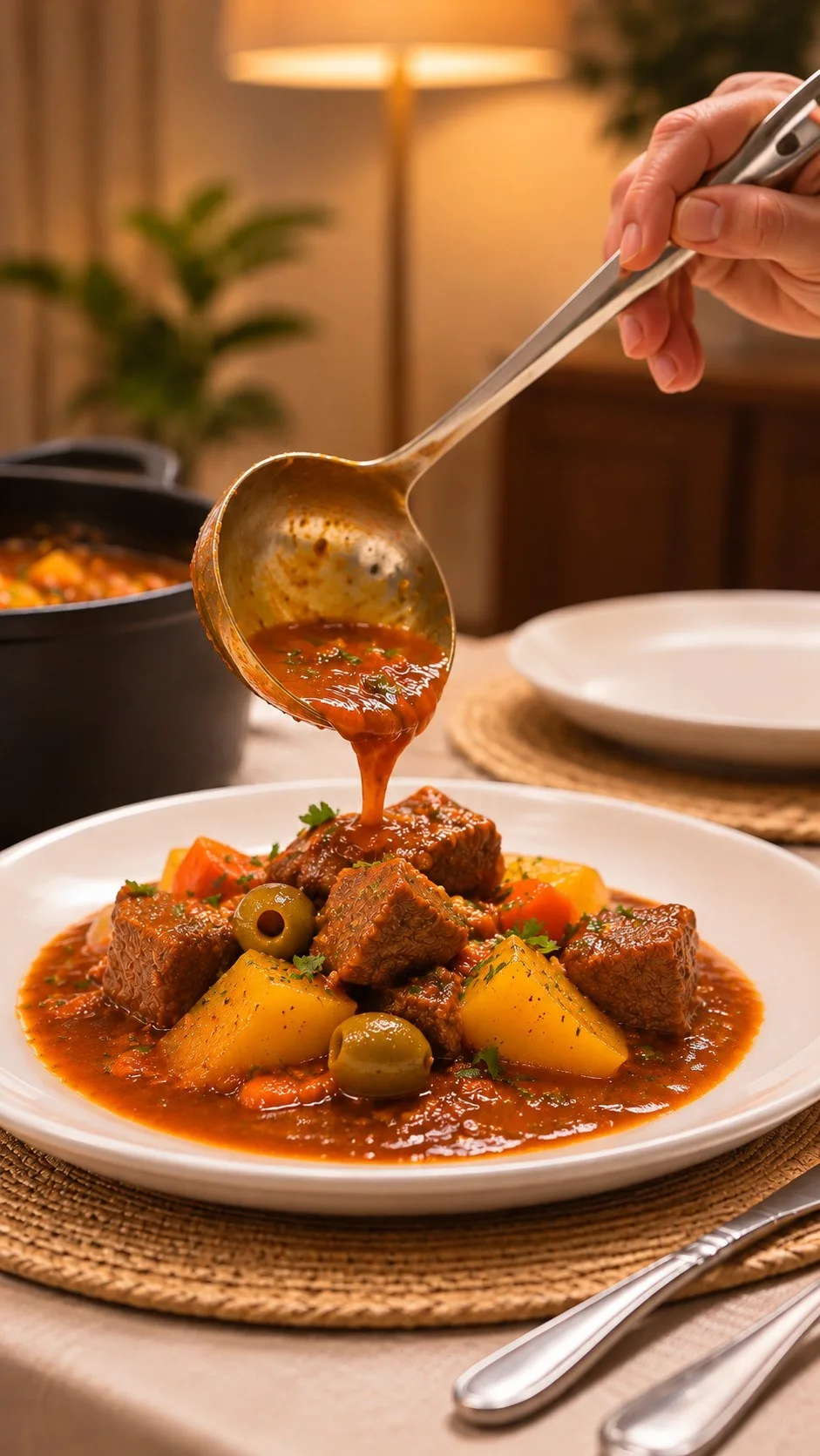
We aim for plenty of sauce, but with body: it should coat the pieces of meat and spread around them when served. All you need is a heavy pot with a lid and a gentle simmer; the olives and parsley are added at the end to preserve their character.
History of beef stew with potatoes and olives
Stew belongs to a broad family of preparations in which meat cooks slowly in a covered pot with liquid and seasonings. Its name relates to that technique, not to a single combination of ingredients. There is no single documented origin for this version with beef, potatoes, and olives.
In central Mexico, we find home-style beef stews with tomatoes, potatoes, and vegetables; this recipe takes that flavor profile as a reference without presenting itself as a specialty exclusive to Mexico City. In neighboring regions, such as the Bajío and Puebla, meat is also prepared in sauce, although ingredients and names vary between communities and households. Guisado and estofado can describe similar preparations, but they are not always identical.
The combination brings together ingredients native to the Americas, such as tomatoes and potatoes, with beef and olives, introduced into the region's diet through colonial exchange. Over time, stews adapted to available ingredients and different cooking methods. The proportion of vegetables, the thickness of the sauce, and the use of olives continue to vary; here we offer a home-style interpretation in keeping with the dish in the photograph.
Why you'll love this recipe
- The meat cooks slowly until it can be pulled apart with a fork.
- The potatoes stay intact and absorb the tomato sauce.
- The green olives provide a salty contrast between bites.
- The entire stew finishes cooking in a single pot.
- The sauce gains body through reduction and the starch from the potatoes, without adding flour.
Beef stew with potatoes and olives
Everything you need, in one place.
- Prep time
- 25 min
- Cook time
- 130 min
- Total time
- 155 min
- Servings
- 4
Ingredients
For the meat and vegetables
For the sauce
To finish and serve
Instructions
Prepare the ingredients
- Cut the beef into approximately 3 cm cubes, removing any visible tough tissue.
- Finely chop the onion and cut the peeled potatoes into 4 cm pieces and the carrots into 2 cm pieces.
- Blend the tomato with the garlic and 200 ml of the broth until you have a smooth sauce.
- Season the meat with salt and pepper just before browning it.
Build the base of the stew
- Brown the meat in the oil in a heavy pot over medium-high heat in two batches, for about 12 minutes total, until a brown crust forms.
- Set the meat aside in a container along with any juices it releases.
- Sauté the onion in the same pot over medium-low heat for 8 minutes, until soft and lightly golden.
- Cook the blended sauce with the cumin and oregano over medium heat for 10 minutes, stirring occasionally, until it thickens and turns a deeper red.
Cook slowly
- Add the meat, its juices, and the remaining 450 ml of broth to the sauce.
- Cook with the pot covered over low heat for 70 minutes, starting when a gentle simmer begins, until the meat starts to yield when pierced.
- Add the potatoes and carrots, nestling them into the sauce.
- Cook with the pot covered over low heat for 25 minutes, until the vegetables can be pierced with a knife and the meat is tender.
- Add the green olives to the pot.
- Keep the stew uncovered over medium-low heat for 5 minutes, until the sauce coats the back of a spoon; adjust the salt at the end.
Serve
- Serve hot on wide plates, with the pieces of meat and vegetables surrounded by sauce and the parsley scattered on top.
Nutrition estimate: 670 kcal — per serving. Values vary with ingredients and portion size.
Tips for getting it right
- Pat the surface of the meat dry before cutting it: moisture makes it harder to brown in the pot.
- When sautéing the onion, make use of the browned bits on the bottom; if any are black, remove them because they can make the sauce bitter.
- Check the meat before adding the vegetables. If it is still firm, extend the cooking time in 15-minute intervals; some cuts need more time than indicated.
- If the sauce reduces too much during cooking, add hot water in increments of 50 ml to 50 ml to keep liquid around the meat.
- Taste an olive before adding them. If it is very salty, rinse the entire portion and drain well.
Common mistakes
- Overcrowding the pot when browning. The meat releases moisture and ends up cooking in its own juices; work in batches and leave space between the cubes.
- Maintaining a vigorous boil. The sauce reduces too much and the vegetables knock against each other; lower the heat until you see small, spaced-out bubbles.
- Adding the potatoes from the start. They fall apart before the beef is tender; add them when the meat is already beginning to yield when pierced.
- Adding too much salt at the beginning. The broth becomes concentrated and the olives add salt; season sparingly and adjust at the end.
Variations and substitutions
- With a touch of chili: add 5 g of dried chipotle chile, rehydrated and seeded, to the tomato mixture for a slightly smoky flavor.
- With peas: replace 100 g of carrot with 100 g of frozen peas and add them during the last 5 minutes.
- With another meat: use 800 g of halal-certified lamb shoulder, cut into evenly sized cubes; check its tenderness before adding the potatoes.
- Outside Mexico: replace the fresh tomatoes with 600 g of unseasoned canned crushed tomatoes, and the Mexican oregano with 1 g of regular dried oregano; the aroma will be different, but the sauce will retain its base.
How to serve and store
Serve the stew hot on a large plate, distributing the meat, potatoes, carrots, and olives, with plenty of sauce around them and a little parsley on top. Refrigerate in shallow containers within the first 2 hours and store for up to 3 days at 4 °C or below. You can freeze it for up to 2 months, although the potatoes may become more mealy; to better preserve the texture, freeze the meat with its sauce and prepare the vegetables when reheating. Thaw in the refrigerator and heat in a covered pot over low heat, with a little water if needed, until it reaches 74 °C in the center.
Short glossary
- Beef chuck
- A cut from the front of the beef carcass, near the shoulder. Its connective tissue softens with slow, moist cooking.
- Tomato
- The common name in much of Mexico for the red tomato. In this recipe, it adds color, acidity, and body to the sauce.
- Sauté
- Cooking an ingredient in a moderate amount of oil over controlled heat. Here it allows the onion to soften before adding the tomato.
- Gentle simmer
- Cooking in which small bubbles appear without vigorous movement. It helps keep the potatoes intact while the meat becomes tender.
Frequently asked questions
What cut can I use if I can't find beef chuck?
Look for halal-certified beef shoulder or ask for a shoulder cut suitable for slow cooking. Avoid very lean cuts intended for quick cooking, as they can turn out dry.
How do I know when the meat is ready?
A fork should go in effortlessly and allow you to separate the fibers with light pressure. If the meat still offers resistance, it needs more gentle cooking; do not turn up the heat to speed up the process.
Can I make it the day before?
Yes. Cook the entire stew, cool it in shallow containers, and refrigerate it within the first 2 hours. The next day, reheat slowly and stir carefully to avoid breaking up the potatoes.
How do I thicken the sauce if it is too thin?
Temporarily remove the meat and vegetables with a slotted spoon and reduce the sauce uncovered over medium-low heat. When it coats the back of a spoon, return the ingredients to the pot.
Can I use water instead of broth?
Yes, replace the 650 ml of broth with the same amount of water. The flavor will be lighter; make the most of browning the meat and adjust the salt at the end.
How did it turn out?
Share your experience or ask a question in the comments.
Leave a comment ↗